See the page CV for a complete publication list
–2023–
Massive intein content in Anaeramoeba reveals aspects of intein mobility in eukaryotes
Lucie Gallot-Lavallee, Jon Jerlström-Hultqvist, Paula Zegarra-Vidarte, Dayana E Salas-Leiva, Courtney W Stairs, Ivan Cepicka, Andrew J. Roger, John M Archibald
Proceedings for the National Academy of Science: 10.1073/pnas.2306381120
Comparative analysis of mitochondrion-related organelles in anaerobic amoebozoans
Kristína Záhonová, Zoltán Füssy, Courtney W. Stairs, Michelle M. Leger, Jan Tachezy, Ivan Čepička6, Andrew J. Roger, Vladimír Hampl
Microbial Genomics: doi.org/10.1099/mgen.0.001143
Adaptation of the late ISC pathway in the anaerobic mitochondrial organelles of Giardia intestinalis
Alžběta Motyčková, Luboš Voleman, Vladimíra Najdrová, Lenka Arbonová, Martin Benda, Vít Dohnálek, Natalia Janowicz, Ronald Malych, Róbert Šuťák, Thijs JG Ettema, Staffan Svärd, Courtney W Stairs, Pavel Doležal
PLoS Pathogens: doi.org/10.1371/journal.ppat.1010773
Inference and reconstruction of the heimdallarchaeial ancestry of eukaryotes
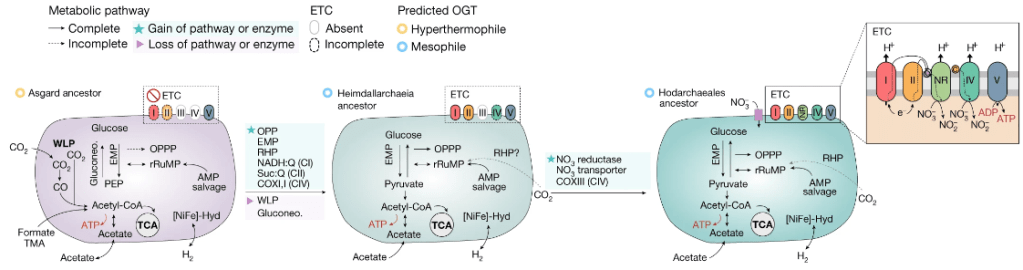
In this study led by collaborators Laura Eme, Daniel Tamarit, and Eva Caceres we explored the nature of our (eukaryotes) earliest ancestors. Courtney helped to reconstruct the metabolic nature of some of the predicted Asgard ancestors to learn more about what our unicellular relatives look like Read more about the study
A mitosome with distinct metabolism in the uncultured protist parasite Paramikrocytos canceri (Rhizaria, Ascetosporea)
Now accepted! A fun collaboration with Ioana Onuț-Brännström and Fabien Burki from Uppsala University where we describe the metabolic potential of a weirdo intracellular parasite of crabs called Paramikrocytosis canceri. It is quite hard to do cell biology on these beasts as they live inside crab cells and cannot be cultured in the lab. But this didn’t scare Ioana away – Ioana sequenced the metagenome and metatranscriptome of infected crab tissue to yield a high-quality draft genome assembly of P. canceri. Together, we manually read through the gene predictions to reconstruct the potential metabolism of the parasite. We found that P. canceri likely possesses a reduced mitochondrion called a mitosome that lacks the canonical features of mitochondria (i.e., does not possess a respiratory chain, Krebs cycle, amino acid metabolism, etc.). Despite being among the most divergent eukaryotes out there, Karla showed that at least two putatively ‘mitochondrial’ P. canceri proteins retain mitochondrial targeted signals that could be recognized during heterologous expression in yeast. Read more about the study here: doi.org/10.1093/gbe/evad022
–2022–
Eukaryotic evolution: Spatial proteomics sheds light on mitochondrial reduction
In this Dispatch article for Current Biology, Michelle Leger and I summarize the exciting cell biology investigations of Justyna Zítek et al. in the December issue. Multi-organelle spatial proteomics has revolutionized animal cell biology, but its use in protists has so far been limited. A new study delivers the first such proteome of a free-living protist, uncovering a previously overlooked function of highly reduced mitochondria. Read more about Justyna’s work in Vladamir Hampl’s lab at Charles University (Czechia).
Life through the lens of metabolism.
Laura Eme and I reviewed Prof. Nick Lane’s latest book “Transformer: the Deep Chemistry of Life and Death” in the September edition of Nature Ecology and Evolution. This captivating read takes us on a journey through the history and molecular details of my favorite metabolic pathway: The Krebs cycle. Check out Prof. Lane’s website for more information about the book and his research. Also, visit Dr. Laura Eme’s homepage for more information about her research.
Evolving perspective on the origin and diversification of cellular life and the virosphere
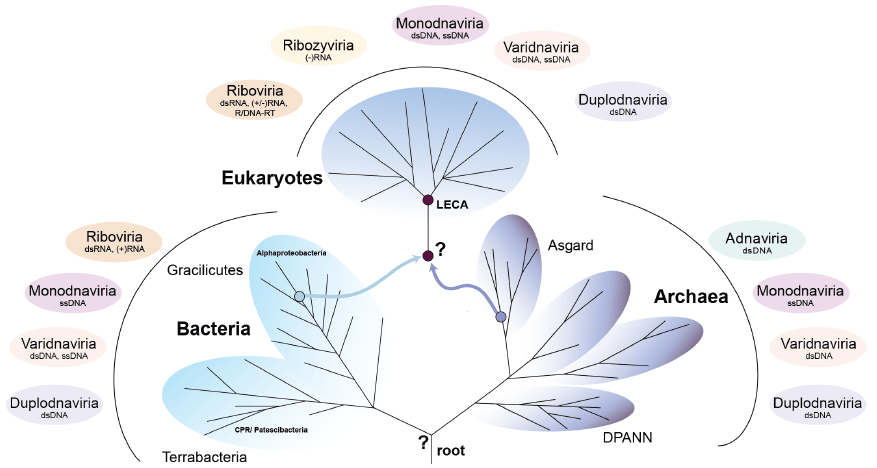
Check out this review by Anja Spang, Tara A Mahendrarajah, Pierre Offre, Courtney Stairs in Genome Biology and Evolution. In here, we discuss the evolution of the different domains of life and viruses. Read more about research by Anja Spang and Tara Mahendrarajah and Pierre Offre at NIOZ.
Hydrogen metabolism: A eukaryote taps into the electron sink

Congrats to Karla Aguilera-Campos on her first paper in the group! In this Dispatch article for Current Biology, Karla and Courtney summarise the recent paper by Smutná et al. who showed a potentially hydrogen-oxidizing hydrogenase is present in the Trichomonas vaginalis. This is the first reported case of a potentially hydrogen-oxidizing eukaryote and one of few example of intracellular hydrogen cycling in a single-cell! Read Smutná et al. here and our dispatch here.
–2021–
Anaeramoebae are a divergent lineage of eukaryotes that shed light on the transition from anaerobic mitochondria to hydrogenosomes

Courtney Stairs, Petr Táborský, Eric D. Salomaki, Martin Kolisko, Tomáš Pánek, Laura Eme, Miluše Hradilová, Čestmír Vlček, Jon Jerlström-Hultqvist, Andrew J. Roger and Ivan Čepička.
Read the paper, its open access! Or check out this blog post on the International Society of Evolutionary Protistology website.
Diversity of electron transport chains in anaerobic protists
Read the paper here, its open access! This was a fun review to write with Dr. Ryan Gawryluk at University of Victoria in Canada. Learn more about Ryan’s research here.

 the lab upStairs